
Bamboo Cave Team
Wisdom Collective
Bamboo Treatment Process: A Complete Guide to Enhancing Durability
Bamboo is one of the most sustainable and versatile construction materials in the world. It is lightweight, strong, flexible, and environmentally friendly. However, untreated bamboo is highly vulnerable to insects, fungi, and environmental degradation because of its naturally high starch and sugar content.
Without proper treatment, bamboo structures may only last 2–3 years. With correct treatment and preservation methods, its lifespan can increase to 15–25 years or more, making it a reliable material for structural and interior applications.
This guide explains the complete bamboo treatment process used to enhance durability, strength, and longevity.
1. Selection and Harvesting
The treatment process begins with choosing the correct bamboo culms.
Key selection criteria include:
- Ideal Age: 3–5 years
- Harvesting Season: Preferably during the dry season
- Quality Check: Avoid immature or over-aged bamboo
Mature bamboo culms have stronger fiber structures and lower starch content, making them more suitable for construction and treatment processes.
2. Primary Preparation
Once harvested, bamboo undergoes initial preparation steps.
These include:
- Removing branches and leaves
- Cutting bamboo into required lengths
- Cleaning the outer surface
- Placing bamboo vertically to allow natural sap drainage
Draining the sap helps reduce sugar content, which is one of the main reasons insects are attracted to bamboo.
3. Pre-Treatment Methods
Before chemical preservation, bamboo is often subjected to pre-treatment processes to reduce starch content.
a) Water Soaking
One of the most traditional and effective techniques.
Process:
- Bamboo is immersed in ponds, rivers, or water tanks
- Duration: 7–20 days
Benefits:
- Leaches out sugars and starch
- Reduces insect attraction
- Improves chemical absorption in later stages
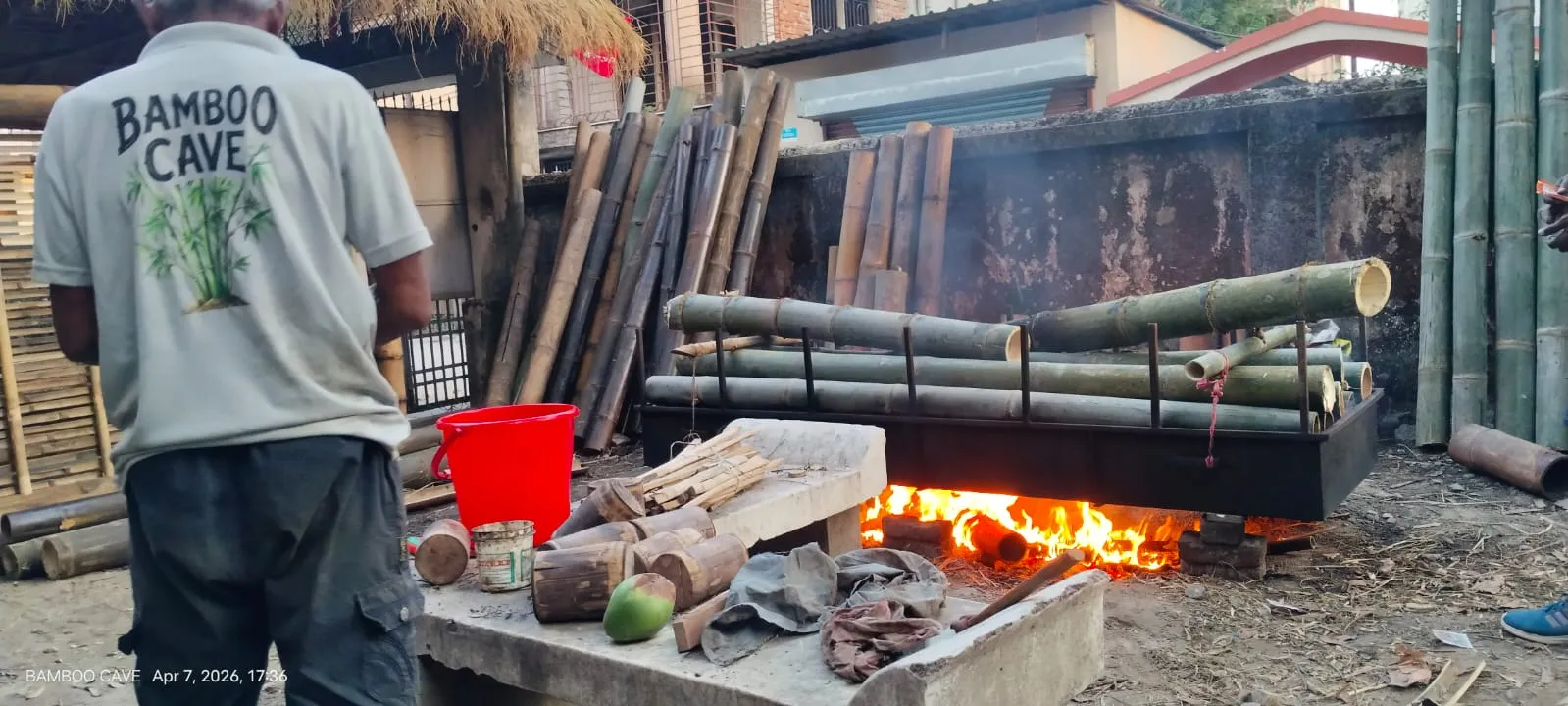
b) Smoking / Heat Treatment
In this method, bamboo is exposed to controlled heat or smoke.
Advantages include:
- Reduction in moisture content
- Increased resistance to fungi and insects
- Improved bamboo color and texture
This method is often used in traditional bamboo processing communities.
4. Chemical Treatment Methods
Chemical preservation is the most important stage for ensuring long-term durability.
a) Boric Acid – Borax Treatment (Most Common Method)
This is the most widely used and environmentally safe bamboo preservative treatment.
Solution ratio:
Boric Acid : Borax = 1 : 1.5
The chemicals are dissolved in water to form a preservative solution.
Application methods include:
Soaking Method
- Bamboo is immersed in the preservative solution
- Duration: Several days
Pressure Treatment
- Chemicals are forced into bamboo using pressure
- Most effective for structural applications
Boucherie Method
- Preservative solution is pushed through fresh bamboo using pressure
- Works best with freshly cut bamboo
Benefits of Boric Acid–Borax treatment:
- Highly effective against insects and fungi
- Non-toxic and eco-friendly
- Maintains bamboo's natural strength and appearance
b) Salt Water Treatment
Another basic preservation technique.
Process:
- Bamboo is either boiled in salt water for 1–2 hours
- Or soaked for several days
Benefits:
- Removes starch
- Provides basic protection against pests
Though useful, this method is generally less effective than boric-borax treatment.
c) Other Chemical Preservatives
For outdoor applications, additional preservatives may be used.
Examples include:
- Copper-based preservatives
- Oil-based preservatives
These treatments provide better weather resistance and durability in outdoor environments.
5. Seasoning (Drying)
After chemical treatment, bamboo must be properly dried to reduce moisture content.
Target moisture level:
12–15%
Two common seasoning methods:
Air Drying (Natural Method)
- Bamboo is stored in a ventilated area
- Duration: 4–8 weeks
Kiln Drying (Controlled Method)
- Uses controlled temperature and humidity
- Faster and more uniform drying
Proper seasoning helps prevent:
- Cracking and splitting
- Fungal growth
- Dimensional changes
6. Surface Finishing
To further enhance durability and appearance, bamboo undergoes finishing treatments.
Common finishing processes include:
- Sanding for smooth surface
- Applying protective coatings such as:
- Varnish
- Polish
- Lacquer
- Sealants
- Anti-UV coatings (for outdoor use)
These finishes protect bamboo from moisture, sunlight, and surface wear.
7. Storage and Handling
Proper storage is essential to maintain treated bamboo quality.
Recommended practices:
- Store in a dry and ventilated area
- Avoid direct ground contact
- Protect from rain and excessive moisture
Good storage practices prevent premature deterioration and fungal growth.
Conclusion
Bamboo treatment plays a critical role in transforming raw bamboo into a durable and reliable building material.
When properly treated and maintained:
- Untreated bamboo lifespan: 2–3 years
- Treated bamboo lifespan: 15–25 years or more
Through processes like chemical preservation, seasoning, and protective finishing, bamboo becomes resistant to pests, fungi, and environmental damage.
With its strength, sustainability, and long lifespan, treated bamboo is increasingly becoming a viable alternative to traditional construction materials in modern architecture and interior design.